
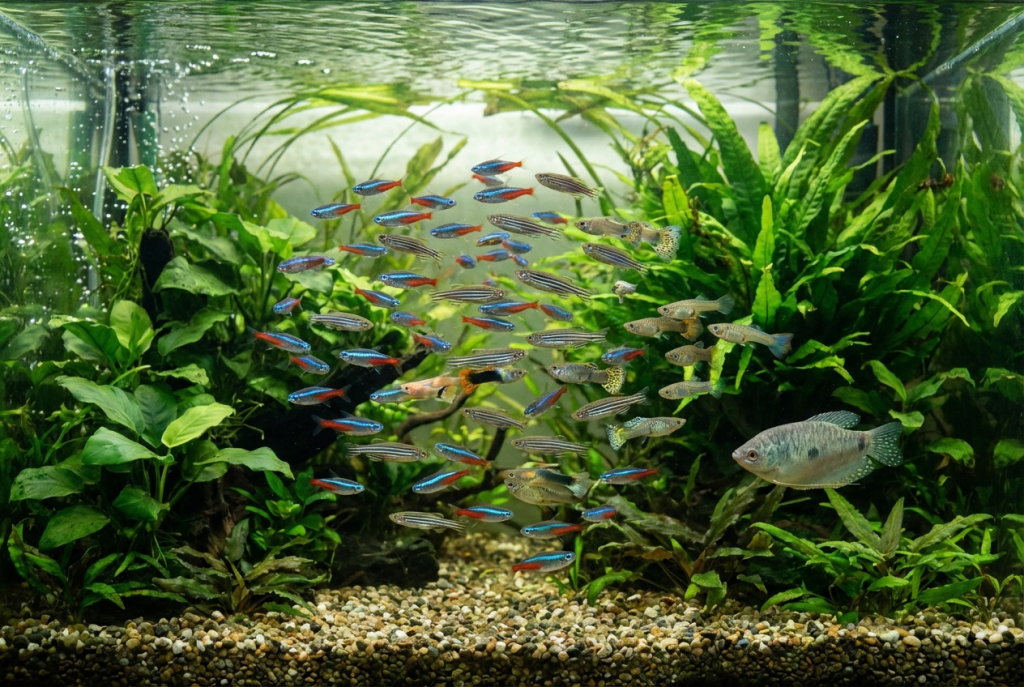

If you’ve ever watched a school of fish glide through the water in perfect harmony, you know how magical it looks. Dozens—or even hundreds—of individuals move like a single living ribbon, turning and shifting with ease. But schooling isn’t just beautiful to watch. It’s a survival strategy that helps fish stay calm, find food, and avoid predators. In the home aquarium, many species continue to rely on this instinct. Because of that, creating the right environment helps these fish thrive in schools. Yet schooling doesn’t always work, especially when the tank conditions or group dynamics aren’t right.
Understanding why fish thrive in schools allows you to keep them healthier and more confident. Even more importantly, knowing when they don’t thrive helps you prevent stress, aggression, and illness. Schooling is deeply tied to biology, safety, and communication, and it can only happen when the environment supports it.
Let’s explore the science behind schooling, the benefits for your fish, and the common reasons schooling behavior breaks down in captivity.
Why Fish Thrive in Schools in Nature
Schooling is a complex behavior shaped by evolution. Wild fish learn early that they must stay alert to survive. Since a lone fish is an easy target, schooling becomes a natural defense.
Fish thrive in schools because of:
- Safety in numbers
- Better movement efficiency
- More food opportunities
- Reduced stress
- Improved breathing and flow
- Simplified navigation
Each of these advantages works together. When fish feel safer, their bodies function better. Stress drops, immune systems strengthen, and behavior becomes calmer.
Because schooling is instinctive, aquarium fish often rely on the same structure to feel secure.
Safety in Numbers: The Core Reason Fish School
The primary reason fish thrive in schools is protection. A predator chasing a swarm of fish becomes confused quickly. The group moves like a single organism, causing predators to misjudge distance and direction. Even if a predator attacks, the odds of any one fish being caught drop sharply.
When fish are kept alone—even peaceful species—they often become jumpy, hide excessively, or eat less. Without the comfort of a group, their natural defenses remain on high alert. Stress hormones rise, making them more vulnerable to disease.
Schooling instantly reduces that fear.
Schooling Helps Fish Save Energy
Moving through water takes effort. When fish swim together, they take advantage of hydrodynamics. Each fish creates tiny currents that help the fish behind them move with less effort. It’s similar to how cyclists draft behind one another in a race.
Because of this, fish thrive in schools since they conserve energy, swim farther, and reach food more efficiently.
Fish kept in too-small groups often pace nervously or dart around the tank. When the group is large enough, swimming becomes smoother and calmer.
Schools Improve Feeding Success
Many small fish eat tiny insects, plankton, or drifting particles. When they move in a group, they collectively disturb the water. This reveals hidden food sources. A school can find far more food than a single fish would alone.
In the aquarium, the same instinct appears. Fish in schools will often approach food together, reducing hesitation. When kept alone, many schooling species become picky or skittish at feeding time.
Because of this, properly sized groups help fish eat regularly and confidently.
Why Fish Thrive in Schools Emotionally
While fish emotions differ from mammals, they still experience forms of stress and comfort. Schooling species feel unsafe when kept alone because isolation goes against millions of years of survival programming.
When grouped correctly, you’ll notice:
- Brighter coloration
- More relaxed swimming patterns
- Frequent exploration
- Less aggression
- Better overall health
Because their instincts tell them they are safe, they behave naturally.
What Makes a Species a “True Schooling Fish”?
Not all fish that gather in groups are true schoolers. There are three general categories:
- Schooling fish: move in tight, synchronized groups
- Shoaling fish: hang out loosely but don’t maintain formation
- Solitary fish: prefer living alone or in pairs
Tetras, rasboras, danios, and Corydoras often school under the right conditions. Gouramis, bettas, and cichlids do not.
Understanding this distinction prevents you from forcing unnatural behavior.
Why Fish Stop Schooling in Aquariums
Even when species thrive in schools naturally, they sometimes refuse to school in captivity. This doesn’t mean they dislike their tank mates. It simply means conditions aren’t triggering the instinct.
Common reasons include:
- Tanks that are too small
- Poorly matched group sizes
- Conflicting tank mates
- Unstable water conditions
- Lack of flow or open space
- Stress or illness
- Overcrowding
- Incorrect lighting
When these issues appear, fish break formation and behave individually.
Because schooling requires confidence, anything that disrupts safety makes schooling collapse.
Tank Size Matters More Than Many Owners Realize
Schooling fish need room to move together. If the tank is too small, they scatter due to limited space. Even species listed for nano tanks often school better in longer or wider aquariums.
A general guideline:
- Small schooling species: minimum 20 gallons
- Medium schooling species: 30–40 gallons
- Active swimmers like danios: long tanks preferred
When space increases, schooling behavior improves immediately.
Group Size Completely Changes Schooling Behavior
One of the biggest misunderstandings in fishkeeping is how many fish schooling species need. A group of three doesn’t count as a school. Even six is often just the minimum for reduced stress.
For true comfort, aim for:
- 8–12 fish for small species
- 12–20 fish for mid-sized species
- 6+ Corydoras for bottom schooling
Because larger groups provide stronger safety signals, fish swim more naturally.
Too few fish = poor schooling
Too many fish = overcrowding stress
Finding balance helps fish thrive.
Tank Mates Influence Schooling Success
Even peaceful tank mates can disrupt schooling if they:
- Move too quickly
- Chase for fun
- Grow much larger
- Compete aggressively for food
- Occupy the same swimming zone
For example, fast barbs may intimidate slower tetras. Large gouramis may cause rasboras to hide. Even nippy livebearers can break schooling formations.
Choosing compatible tank mates helps schooling remain strong.
Water Conditions Affect Confidence and Schooling
When water quality is poor, fish behave abnormally. Because stress rises under unstable conditions, schooling breaks down quickly.
Support schooling by monitoring:
- Ammonia
- Nitrite
- Nitrate
- pH
- Temperature
- Flow
- Oxygen
Because stable water creates predictable comfort, fish return to natural schooling behavior.
Providing Open Space Encourages Schooling
Fish need “runway space” to move as a group. When decorations clutter the tank, or hiding areas dominate the scape, fish lose their path.
To encourage schooling:
- Place taller plants along side or back walls
- Leave the center area open
- Use driftwood sparingly
- Avoid over-decorating
A well-planned layout instantly improves schooling behavior.
Lighting Can Influence Schooling Behavior
Lighting affects how fish perceive threats. Dim lighting often encourages schools to tighten up. Bright lighting may cause some species to spread out.
If your fish scatter constantly:
- Add floating plants
- Lower intensity slightly
- Provide shaded areas
Because lighting affects mood, adjusting it can bring schools together again.
Stress Reduces Schooling Instincts
When fish feel stressed, they focus on survival rather than coordination. Common stressors include:
- Fast or aggressive tank mates
- Sudden movement near the tank
- Vibrations
- Strong current
- High traffic rooms
Eliminating stress helps your fish return to natural patterns quickly.
Sick Fish Rarely School Properly
Illness disrupts group behavior. Sick fish drift away or hide, signaling discomfort.
Watch for:
- Ragged fins
- Difficulty swimming
- Fading color
- Clamped fins
- Lethargy
- Skipping meals
Identifying problems early stops disease from spreading and protects the school.
Breeding Behavior Temporarily Overrides Schooling
When fish enter breeding mode, they often stop schooling. Some males separate to court females. Others guard eggs and become territorial.
This is natural and temporary.
Once breeding ends, schooling usually resumes.
Predator-Free Tanks Sometimes Reduce Schooling
In the wild, schooling is partly a defense. In a safe aquarium with no predators, fish may relax and spread out. They still benefit from having companions but may not swim in perfect formation.
This behavior is normal, not a sign of stress.
Why Some Species Thrive Without Schooling
Not all fish thrive in schools. Some prefer solitary lives or small pairs.
Examples include:
- Bettas
- Angelfish
- Gouramis
- Many cichlids
- Some catfish
Because they evolved differently, forcing them into groups increases aggression or fear.
Understanding species needs helps you avoid accidental stress.
How to Encourage Natural Schooling in Your Aquarium
If you want to support schooling behavior, focus on:
- Bigger groups
- Proper tank size
- Compatible tank mates
- Stable water quality
- Good lighting
- Open swimming areas
- Low-stress environments
When conditions align, fish school fluidly and confidently. Their colors brighten, their movement becomes synchronized, and your aquarium becomes peaceful and active.
Conclusion
Fish school because it keeps them safe, healthy, and calm. When conditions are right, schooling becomes one of the most beautiful and natural behaviors in your aquarium. But when something is off—whether group size, tank mates, water quality, or stress—schooling breaks apart.
By understanding why fish thrive in schools and when they don’t, you can create an environment where your fish feel secure. A well-designed tank encourages natural behavior, supports long-term health, and transforms your aquarium into a truly harmonious ecosystem.
FAQ
1. Why do my schooling fish stop swimming together?
They may feel stressed, overcrowded, or uncomfortable. Water issues or incompatible tank mates also cause separation.
2. How many fish do I need for a true school?
Most species need at least 8–12 to feel safe, though some require more for natural behavior.
3. Can schooling fish live alone?
They can survive alone but not thrive. Isolation causes stress, dull colors, and timid behavior.
4. Do schooling fish always move in tight groups?
Not always. If the tank feels safe, they may spread out slightly but stay aware of each other.
5. Which fish are the best schooling species for beginners?
Neon tetras, rasboras, danios, and Corydoras are reliable, peaceful, and easy to care for.