
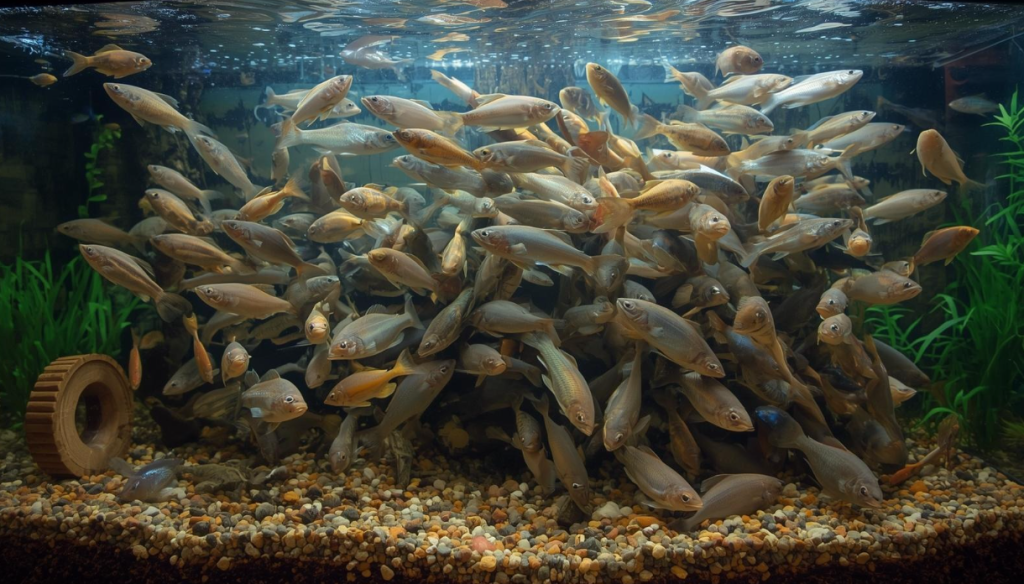

Overcrowding reduces fish activity in ways that are easy to miss at first. A tank may look busy and colorful, yet movement often fades beneath the surface. Instead of confident swimming, fish hover, hide, or drift slowly. These changes rarely happen overnight. Instead, they develop quietly as stress builds.
Fish rely on space to move, explore, and establish comfort zones. When too many fish share a limited area, natural behavior is suppressed. Although the aquarium may appear calm, that calmness often reflects exhaustion rather than wellbeing.
Think of a crowded aquarium like a traffic jam. Cars still move, but progress slows. Frustration increases. Eventually, everything grinds down. Fish experience a similar breakdown when space disappears.
Understanding how crowding affects behavior helps aquarists correct problems before health declines.
Why Overcrowding Reduces Fish Activity in Confined Tanks
Fish movement depends on available swimming space. When tanks become crowded, every movement requires effort and awareness. As a result, fish conserve energy.
Overcrowding reduces fish activity because constant proximity triggers stress responses. Instead of exploring, fish prioritize survival. Hiding increases. Interaction decreases.
Additionally, social structures collapse. Dominant fish patrol aggressively, while submissive fish retreat. Consequently, overall movement drops across the tank.
Even peaceful species suffer when personal space disappears.
Stress and Hormonal Changes in Crowded Aquariums
Stress plays a central role in reduced activity. In crowded environments, cortisol levels remain elevated.
When fish live under constant stress, energy is diverted from movement and growth. Immunity weakens. Healing slows.
Rather than swimming freely, fish adopt low-energy behaviors. This response protects them short-term but causes long-term harm.
Crowding does not create peace. It creates pressure.
Swimming Space and Natural Movement Patterns
Different species require different swimming styles. Some glide continuously. Others dart between cover.
Overcrowding reduces fish activity by disrupting these patterns. Turns become sharp. Collisions increase. Routes disappear.
Without space to swim naturally, muscles weaken and endurance drops. Over time, fish adapt by moving less.
That adaptation signals compromise, not comfort.
Territorial Stress When Too Many Fish Share Space
Many fish are territorial by instinct. Space defines safety.
In crowded aquariums, territorial boundaries overlap constantly. Chasing becomes frequent. Rest becomes rare.
As a result, energy drains quickly. Submissive fish hide continuously. Dominant fish exhaust themselves.
Crowding reduces fish activity because no fish truly relaxes.
Oxygen Levels and Reduced Energy
Fish share oxygen dissolved in water. More fish means faster depletion.
When oxygen drops, fish reduce movement to conserve energy. Surface gasping may appear in severe cases.
Even with good filtration, space still matters. Water quality and oxygen are linked, but they are not interchangeable.
Adequate space supports healthy respiration and normal activity.
Waste Accumulation and Behavioral Suppression
More fish produce more waste. Ammonia and nitrate rise faster in crowded tanks.
Poor water quality irritates gills and skin. Fish respond by limiting movement.
Overcrowding reduces fish activity because swimming becomes physically uncomfortable.
Regular maintenance helps, but it cannot replace space.
Feeding Competition in Overcrowded Aquariums
Crowded tanks create uneven feeding dynamics. Aggressive feeders dominate. Shy fish retreat.
Some fish overeat. Others receive too little. Energy levels become inconsistent.
Reduced nutrition leads to reduced movement. Overfed fish become sluggish. Underfed fish lack stamina.
Balanced stocking promotes fair feeding and stable activity.
Schooling Fish and Crowding Myths
Schooling fish are often misunderstood. While they live in groups, they still require space.
Overcrowding reduces fish activity even in schooling species when tanks restrict movement.
Schools need room to turn and synchronize. Without it, schooling breaks down into stress-driven clustering.
Group size never replaces swimming space.
Bottom Dwellers and Hidden Effects of Overcrowding
Bottom dwellers rely on floor space. Crowding affects them silently.
When space disappears, hiding becomes constant. Feeding behavior changes.
Reduced movement often goes unnoticed because it happens out of sight.
Proper stocking must consider vertical and horizontal space together.
Inactive Fish Are Not Calm Fish
Stillness is often misread as contentment. However, suppressed behavior reflects stress.
Healthy fish investigate, react, and explore.
Overcrowding reduces fish activity through behavioral shutdown, not relaxation.
Behavioral observation remains the best early warning system.
Long-Term Effects of Overcrowding on Fish Activity
Crowding damage accumulates over time. Early signs may seem minor.
Eventually, fish lose interest in their environment entirely. Recovery becomes harder.
Reducing population early allows behavior to rebound.
Delayed action increases permanent harm.
Growth, Development, and Crowded Conditions
Young fish need space to develop properly. Crowding releases growth-inhibiting hormones.
Stunted fish may appear healthy but suffer internally.
Reduced activity and reduced growth often appear together.
Proper spacing supports normal development.
Disease Spread in Overcrowded Tanks
Disease spreads faster when fish live in close contact.
Stress weakens immunity. Parasites move easily.
Crowded environments become disease incubators.
Space acts as a natural barrier to outbreaks.
For stocking guidance, tools like https://aqadvisor.com provide useful estimates.
Environmental Enrichment Cannot Replace Space
Decorations add interest but require room to matter.
Overcrowding reduces fish activity even in heavily decorated tanks.
Open swimming lanes are essential.
Enrichment works best when space already exists.
Filtration Versus Stocking Balance
Strong filters help manage waste, not behavior.
Even well-filtered tanks suffer when overcrowded.
Swimming space cannot be filtered into existence.
Stocking balance always comes first.
Recognizing When a Tank Is Overcrowded
Watch for constant hiding, reduced exploration, or fin clamping.
Observe feeding behavior closely.
Behavior changes appear before disease.
For more care tips, see Aquarium Care Basics.
How to Restore Activity Safely
Reducing stock is the most effective solution. Rehoming may be necessary.
Upgrading tank size helps immediately.
Rearranging décor can improve flow but should not replace downsizing.
Once stress drops, activity often returns quickly.
Ethical Aquarium Keeping and Space
Fish rely entirely on their environment.
Providing adequate space is a welfare responsibility.
Crowded tanks prioritize appearance over health.
Ethical aquariums value movement over numbers.
For deeper insight, resources like https://www.fishkeepingworld.com explain species-specific needs well.
Conclusion
Overcrowding reduces fish activity by increasing stress, restricting movement, and degrading water conditions. What looks calm often hides discomfort.
Healthy aquariums prioritize space, compatibility, and balance. When fish have room to swim and rest, natural behavior returns.
Active fish are healthy fish. Space makes that possible.
FAQ
1. How do I know if my tank is overcrowded?
Reduced movement, hiding, and uneven feeding often signal crowding before illness appears.
2. Can filtration prevent problems caused by too many fish?
Filtration helps water quality but cannot prevent behavioral stress caused by limited space.
3. Do fish adapt to crowded conditions?
They may reduce activity, but that adaptation reflects stress, not comfort.
4. Will activity improve if I remove fish?
Yes, many fish regain normal behavior quickly once stress levels drop.
5. Are larger tanks always better for activity?
Generally proven. More space supports movement, territory, and healthier behavior.