
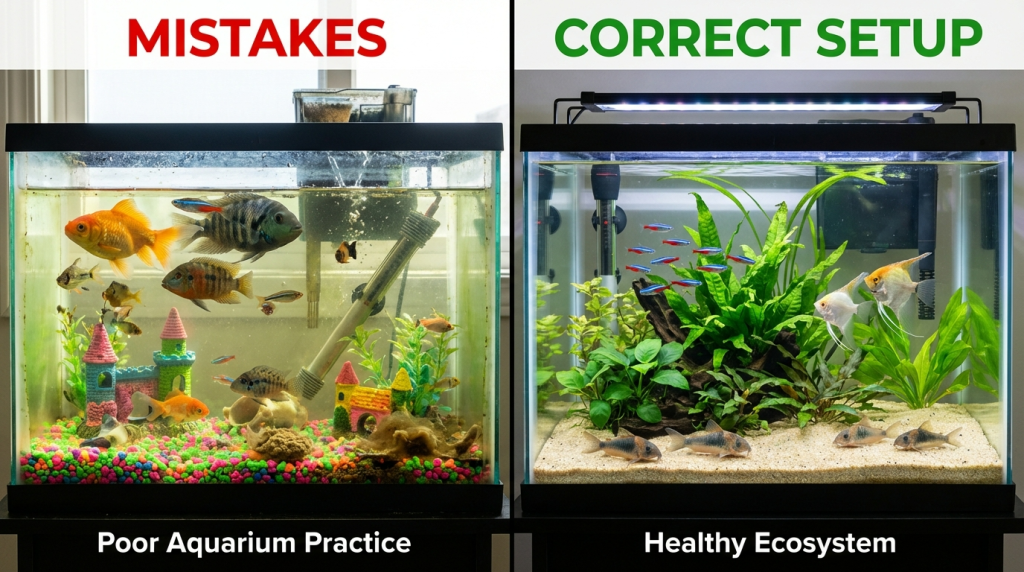

Aquarium setup mistakes are one of the leading causes of fish illness and premature death. Many beginners focus on decorations and colorful gravel. However, fish care begins long before the first fish enters the tank.
Unlike dogs or cats, fish live entirely within the environment you create. Every drop of water, every filter choice, and every temperature adjustment affects them directly. Therefore, even small aquarium setup mistakes can have serious consequences.
The good news is simple. Most problems are preventable. By understanding common errors and correcting them early, you can build a healthy aquatic ecosystem that supports thriving fish rather than struggling survivors.
Let’s explore the mistakes that cause harm and the steps that protect your tank.
Skipping the Nitrogen Cycle: The Most Dangerous Aquarium Setup Mistake
One of the most harmful aquarium setup mistakes is skipping the nitrogen cycle.
When fish produce waste, ammonia forms in the water. Ammonia is toxic. In a healthy tank, beneficial bacteria convert ammonia into nitrite and then into nitrate. This process is called the nitrogen cycle.
However, if fish are added to an uncycled tank, ammonia levels rise quickly. As a result, fish experience stress, burned gills, and possible death.
Cycling takes time. Typically, it requires several weeks before bacteria colonies stabilize. Therefore, patience is critical.
Test water parameters regularly before introducing fish. Ammonia and nitrite levels should read zero before stocking.
Overstocking the Tank Too Quickly
Another common aquarium setup mistake involves adding too many fish at once.
Each fish contributes waste. When stocking exceeds biological filtration capacity, ammonia spikes occur.
Additionally, overcrowding increases stress. Fish require territory and space to swim. Without it, aggression and disease spread rapidly.
A good rule is to add fish gradually. Allow the biological filter to adjust after each addition.
Because stability matters more than speed, slow stocking prevents long-term problems.
Choosing the Wrong Tank Size
Small tanks may look convenient. However, they are less stable.
One overlooked aquarium setup mistake is underestimating space requirements. Smaller volumes of water fluctuate in temperature and chemistry more quickly.
Large tanks dilute toxins more effectively. They also provide room for swimming and hiding.
Research species needs carefully. Some fish grow much larger than expected.
Investing in appropriate tank size from the start avoids stress and costly upgrades later.
Ignoring Water Parameters
Water chemistry shapes fish health.
pH, hardness, ammonia, nitrite, and nitrate levels must be monitored consistently. Aquarium setup mistakes often involve neglecting testing.
Fish adapted to soft water may struggle in hard water. Sudden pH shifts shock sensitive species.
Use a reliable test kit weekly during initial setup.
Stable water parameters support immune health and natural behavior.
Improper Filtration Setup
Filters are the lungs of your aquarium.
One critical aquarium setup mistake is choosing filtration that is too weak for the tank size. Conversely, excessive flow may stress delicate species.
Biological filtration is essential for breaking down waste. Mechanical filtration removes debris. Chemical filtration handles impurities.
Balance these components according to tank size and fish type.
Regular maintenance also matters. However, never replace all filter media at once. Beneficial bacteria live there.
Neglecting Temperature Control
Fish are sensitive to temperature shifts.
An aquarium setup mistake many beginners make is relying on room temperature alone. Most tropical fish require stable warmth between 74°F and 80°F.
Use a reliable heater with a thermostat. Additionally, place a thermometer in the tank to monitor consistency.
Sudden temperature changes weaken immune systems. Stability reduces stress.
Coldwater species require specific ranges as well. Research each fish’s needs carefully.
Adding Fish Without Quarantine
Disease spreads quickly in confined spaces.
One overlooked aquarium setup mistake is skipping quarantine procedures. New fish may carry parasites or bacterial infections.
Quarantine tanks allow observation before introduction into the main tank.
Although this step requires extra effort, it prevents widespread illness.
Healthy fish begin with cautious introduction.
Poor Substrate and Decoration Choices
Substrate affects more than aesthetics.
Certain fish require sand for natural behavior. Others thrive with gravel.
Sharp decorations may damage fins. Additionally, overcrowding the tank with décor reduces swimming space.
Aquarium setup mistakes often prioritize appearance over function.
Choose decorations that support fish behavior and provide hiding spots.
Balance beauty with practicality.
Inconsistent Water Changes
Water changes remove accumulated nitrate and replenish minerals.
One of the simplest aquarium setup mistakes is neglecting regular maintenance.
Weekly partial water changes of 20 to 30 percent are recommended for most tanks.
Always dechlorinate tap water before adding it.
Consistent maintenance prevents toxic buildup.
Overfeeding and Its Impact on Setup
Overfeeding contributes to waste accumulation.
Excess food decays into ammonia. Therefore, feeding habits directly influence water quality.
Aquarium setup mistakes often include feeding too much in the early stages.
Feed small portions that fish consume within two minutes.
Controlled feeding supports both health and water stability.
Incompatible Species Selection
Compatibility matters.
Mixing aggressive fish with peaceful species leads to injury and stress.
Additionally, combining fish with different temperature or pH needs creates imbalance.
Research compatibility before purchase.
Avoid impulse additions that disrupt the ecosystem.
Lack of Live Plants
Live plants enhance stability.
They absorb nitrate and produce oxygen. While not mandatory, they reduce aquarium setup mistakes linked to nutrient imbalance.
Plants also provide shelter and natural enrichment.
However, ensure lighting and substrate support plant health.
Balanced ecosystems mimic natural habitats.
Poor Lighting Management
Lighting affects both fish and plants.
Leaving lights on too long encourages algae growth. On the other hand, insufficient lighting harms plants.
Most aquariums require 8 to 10 hours of light daily.
Use timers to maintain consistency.
Balanced lighting reduces stress and prevents algae overgrowth.
Skipping Research Before Setup
Preparation prevents mistakes.
Many aquarium setup mistakes happen because research was rushed.
Each species has unique needs. Saltwater tanks require different preparation than freshwater tanks.
Understand requirements before filling the tank.
Knowledge protects fish from preventable harm.
Stress and Its Long-Term Effects
Stress weakens immunity.
When aquarium setup mistakes create unstable conditions, fish become vulnerable to disease.
Clamped fins, faded color, and hiding behavior indicate distress.
Correcting environmental issues often restores health without medication.
Stable environments promote vibrant behavior.
Conclusion: Build Stability, Protect Life
Aquarium setup mistakes harm fish because fish cannot escape poor conditions. They rely entirely on the environment you design.
Cycling the tank properly, monitoring water quality, choosing compatible species, and maintaining stable temperature form the foundation of success.
Avoid rushing. Prioritize research and patience.
When stability is achieved, fish thrive. Colors brighten. Behavior becomes natural and confident.
An aquarium is not just decoration. It is a living ecosystem.
Build it carefully, and your fish will reward you with health and beauty for years.
FAQs
- What is the most common aquarium setup mistake?
Skipping the nitrogen cycle is one of the most harmful mistakes beginners make. - How long should I cycle a tank before adding fish?
Cycling typically takes four to six weeks, depending on conditions. - How often should I change aquarium water?
Most tanks require weekly partial water changes of about 20 to 30 percent. - Can I add multiple fish at once?
It is better to add fish gradually to allow biological filtration to adjust. - Why are my fish stressed in a new tank?
Unstable water parameters, improper temperature, or overcrowding may be causing stress.