Bearded dragons look tough. Spiky scales. Ancient posture. Calm confidence. However, behind that rugged appearance lies a reptile that depends completely on precise environmental conditions. Among all aspects of care, nothing matters more than bearded dragon lighting and temperature.
Without correct lighting, digestion fails. Bones weaken. Immunity drops. Without proper temperatures, metabolism slows and illness follows. In other words, food, supplements, and handling mean little if lighting and heat are wrong.
Think of lighting and temperature as the engine and fuel of your bearded dragon’s life. When both run smoothly, everything else works better. When they don’t, problems appear quietly but persistently.
This guide explains exactly how to create the ideal lighting and temperature setup so your bearded dragon can thrive, not just survive.
Why Bearded Dragon Lighting and Temperature Matter
Bearded dragons are ectothermic. That means they rely on external heat and light to regulate internal processes. In the wild, they bask under intense Australian sun for hours daily. That exposure drives digestion, calcium absorption, and energy levels.
In captivity, lighting and temperature must replace the sun. Unfortunately, many setups fall short. Weak UVB, improper heat gradients, or incorrect placement lead to metabolic bone disease, lethargy, and shortened lifespan.
Bearded dragon lighting and temperature work together. Heat without UVB fails. UVB without heat fails. Balance creates health.
Understanding the Natural Habitat
Understanding nature simplifies setup.
In the wild, bearded dragons live in arid regions with intense sunlight, hot basking zones, and cooler retreats. Temperatures fluctuate daily, yet gradients always exist.
They bask early, forage mid-day, and retreat when overheated. This behavior depends on environmental choice.
Your enclosure must offer that same choice through proper lighting and temperature zones.
The Role of UVB in Bearded Dragon Lighting
UVB lighting is non-negotiable.
UVB allows bearded dragons to synthesize vitamin D3, which enables calcium absorption. Without it, bones weaken regardless of diet or supplements.
Symptoms of UVB deficiency appear slowly. Tremors. Soft jaws. Curved limbs. By the time they appear, damage is already severe.
High-quality UVB lighting prevents these issues entirely when used correctly.
Choosing the Right UVB Bulb
Not all UVB bulbs are equal.
Linear fluorescent UVB tubes are strongly recommended. T5 HO UVB bulbs provide consistent output and better coverage than compact bulbs.
A UVB output of 10.0 to 12% works best for bearded dragons. Lower levels are insufficient. Higher levels require careful placement.
Avoid cheap or unknown brands. Quality matters because UVB output degrades over time.
Reliable bearded dragon lighting starts with the right bulb.
UVB Placement and Distance
Placement determines effectiveness.
UVB bulbs should run across at least two-thirds of the enclosure length. This ensures exposure during natural movement.
Distance matters. Typically, T5 UVB bulbs should sit 12 to 18 inches above the basking area, depending on reflector strength.
UVB should overlap the basking zone so heat and UVB occur together.
Separated zones reduce effectiveness.
How Long Should UVB Lights Stay On
Consistency supports health.
UVB lighting should remain on for 12 to 14 hours daily, mimicking daylight cycles. Timers help maintain consistency.
Lights should turn off completely at night. Darkness supports natural sleep patterns.
Irregular cycles disrupt hormones and stress the reptile.
Heat Lamps and Basking Temperature Explained
Heat drives digestion.
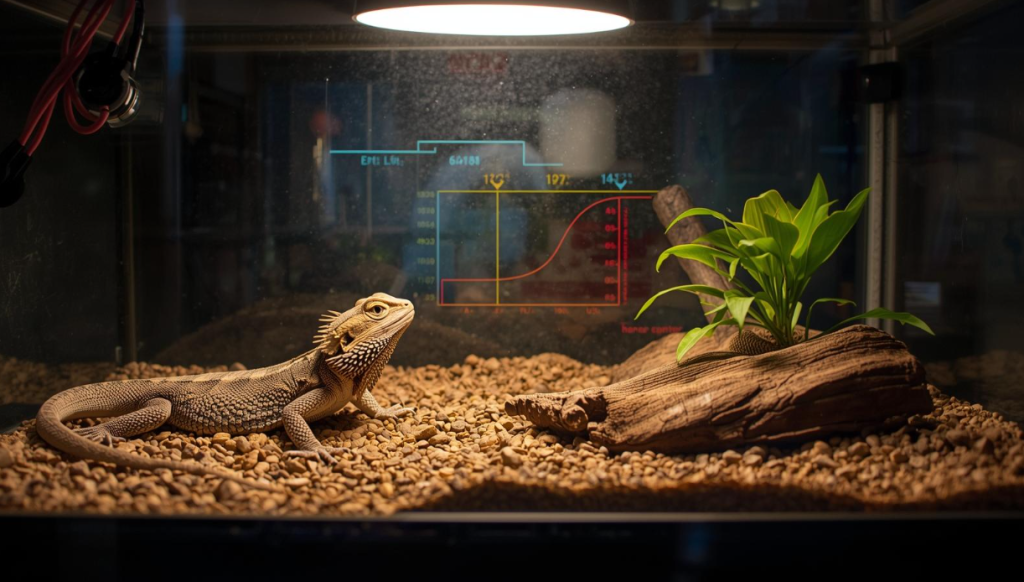
Bearded dragons require a basking spot between 100 and 110°F for adults. Juveniles often prefer slightly warmer zones.
Use a dedicated basking bulb rather than ceramic heat alone during the day. Visible light encourages natural basking behavior.
The basking surface temperature matters more than air temperature. Infrared thermometers measure this accurately.
Correct basking temperature ensures proper digestion.
Cool Side Temperatures Matter Too
Gradients allow choice.
The cool side of the enclosure should stay between 75 and 85°F during the day. This allows the dragon to regulate body temperature naturally.
Without a cool zone, overheating occurs. Chronic overheating causes dehydration and stress.
Bearded dragon lighting and temperature must always include a gradient.
Nighttime Temperature Requirements
Night brings change.
Bearded dragons tolerate cooler nighttime temperatures. Drops to 65–75°F are safe and natural.
If your home becomes colder, ceramic heat emitters or radiant heat panels provide warmth without light.
Never use colored night bulbs. They disrupt sleep and stress reptiles.
Darkness matters as much as warmth.
Measuring Temperature Correctly
Guessing leads to mistakes.
Use digital probe thermometers on both warm and cool sides. Use an infrared temperature gun for basking surfaces.
Dial thermometers are unreliable and inaccurate.
Accurate measurement prevents overheating and underheating.
The Importance of Thermostats
Thermostats protect lives.
Every heat source should connect to a thermostat. Unregulated heat sources cause burns or fatal overheating.
Thermostats maintain consistent temperatures and prevent fluctuations.
Safety begins with control.
Bulb Types to Avoid
Some bulbs cause harm.
Mercury vapor bulbs combine heat and UVB but are difficult to regulate. Incorrect placement causes overexposure.
Colored bulbs distort vision and disrupt circadian rhythm.
Cheap compact UVB bulbs fail to provide adequate coverage.
Avoiding poor equipment prevents long-term damage.
Seasonal Adjustments in Lighting and Temperature
Seasonal awareness helps.
During winter, ambient room temperatures may drop. Supplemental heat may be needed.
Lighting duration can remain consistent year-round for captive dragons. However, slight adjustments may benefit breeding adults.
Stability always outweighs experimentation.
Juvenile vs Adult Bearded Dragon Needs
Age influences preferences.
Juveniles require slightly higher basking temperatures to support rapid growth. Adults prefer slightly cooler basking zones.
UVB strength remains consistent for all ages.
Adjusting temperature gradually supports development.
How Lighting Affects Appetite and Behavior
Lighting influences mood.
Proper bearded dragon lighting increases appetite, alertness, and exploration. Poor lighting causes lethargy and hiding.
Behavior often improves dramatically after lighting correction.
Light fuels activity.
Shedding and Lighting
Shedding stresses the body.
During shedding, proper UVB and heat support skin turnover and healing. Poor conditions prolong shedding and cause retained skin.
Humidity hides help locally without raising overall humidity.
Support the body during transition.
Common Lighting and Temperature Mistakes
Mistakes happen easily.
UVB bulbs placed too far away. Basking spots too cool. No temperature gradient. Lights left on at night.
Each mistake compounds stress.
Learning prevents repetition.
Replacing Bulbs on Schedule
UVB degrades silently.
Most UVB bulbs need replacement every 6 to 12 months, even if they still produce visible light.
Mark replacement dates to avoid forgotten degradation.
Fresh bulbs maintain effectiveness.
Enclosure Size Affects Lighting Setup
Size matters.
Smaller enclosures create narrow gradients. Larger enclosures allow natural movement.
Minimum adult enclosure size is 4x2x2 feet. Smaller enclosures complicate proper lighting and temperature balance.
Space simplifies setup.
Using Natural Sunlight Safely
Natural sunlight is powerful.
Supervised outdoor time offers excellent UVB exposure. However, glass blocks UVB completely.
Never leave bearded dragons unattended outdoors.
Sunlight supplements but does not replace enclosure lighting.
Monitoring Health Through Behavior
Behavior reflects environment.
A healthy dragon basks daily, eats regularly, and explores calmly. Reduced basking or appetite often indicates lighting or temperature issues.
Observe patterns, not moments.
Long-Term Health Benefits of Proper Setup
Correct bearded dragon lighting and temperature prevent disease.
Metabolic bone disease, digestive issues, and immune weakness decrease dramatically.
Lifespan increases. Quality of life improves.
Prevention always beats treatment.
Conclusion
Bearded dragon lighting and temperature form the foundation of proper care. Without correct UVB exposure and heat gradients, even the best diet and supplements fail. When lighting and temperature mimic nature, bearded dragons thrive.
By investing in quality equipment, accurate measurement, and consistent routines, you create an environment where health becomes the norm instead of the exception. Lighting and temperature are not accessories. They are life support. Get them right, and everything else falls into place.
FAQ
1. How long should bearded dragon lights stay on each day?
Most bearded dragons need 12 to 14 hours of light daily to support natural rhythms.
2. Can bearded dragons get too much UVB?
Yes, improper placement or overly strong bulbs can cause eye and skin issues.
3. Do bearded dragons need heat at night?
Only if temperatures drop below 65°F. Darkness should always be preserved.
4. How often should UVB bulbs be replaced?
Most UVB bulbs should be replaced every 6 to 12 months, even if they still glow.
5. Why isn’t my bearded dragon basking?
Incorrect temperatures, weak UVB, or stress often cause reduced basking behavior.