
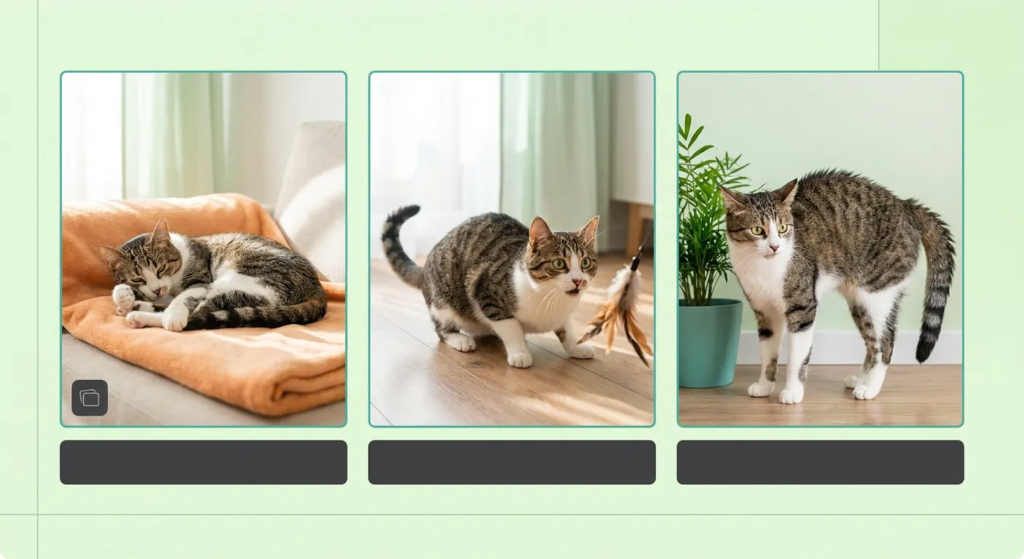

Understanding cat body language means looking at the whole cat in context. Tail position, ears, eyes, posture and movement can offer clues, but one signal is not a reliable dictionary translating every cat’s feelings. This beginner guide explains useful observations, illustrates their limits and helps you decide what information to share with a veterinarian when something concerns you.
The goal is considerate interaction rather than a diagnosis made from a photograph. A cat can display a similar behavior in different circumstances. Avoid assigning a fixed personality label or assuming that an apparently familiar signal permits handling whenever you want.
Observe before interpreting
A Journal of Feline Medicine and Surgery — Assessing Feline Emotions published in 2018 explains that feline emotions are difficult to identify from behavior alone: the same behavior can occur with different emotional motivations. It emphasizes interpreting behavior, posture and facial expressions together with context. The article is a clinical review, not a validated home test that measures a cat’s feelings with certainty.
Start with a description of what is visible. Instead of writing angry, note that the cat crouched, drew its ears back and moved away when someone approached. Then add the circumstances: who was present, what happened immediately before and whether the cat had an accessible route away. Leave the emotional interpretation tentative.
This distinction is useful when two people describe the same cat differently. One may have observed a quiet room and another a crowded doorway. Neither observation automatically represents the cat in every setting. Comparing circumstances can reveal what remains unknown without inventing a universal explanation for the individual animal.
Read posture, tail, ears and eyes together
The RSPCA — Cat Body Language guide illustrates a relaxed standing cat with loose posture, naturally positioned ears and an upright tail with a curved tip. Its worried-cat examples combine tension, a crouched body, a tightly held tail and changed ear or pupil appearance. These are patterns to consider together, not guarantees that a single feature always means one thing.
For a hypothetical observation exercise, imagine one cat standing with a loosely held body and another crouching tightly behind a chair. Describe the difference before assigning an emotion. Add what each was responding to. The exercise supplies no actual animal assessment and should not be used to decide that either cat has a clinical condition.
Tail descriptions should also be precise. Record held upright, held close to the body or moving rather than treat every movement as a fixed message. Keep the other visible features and surrounding activity in the note. A clipped video that shows only the tail may omit the context needed for a meaningful interpretation.
Ears are one part of the picture
RSPCA’s guide includes flattened or sideways-positioned ears within uncomfortable or tense body-language combinations. Observe both ears and the rest of the cat rather than interpreting a fleeting movement alone. Do not label every ear rotation as fear or claim that forward ears make an interaction safe.
A useful notebook description can say ears turned toward a sound while the body remained in its previous position. That records what was seen. The additional statement that the cat loved the sound would require an interpretation you have not established simply by observing orientation.
When an ear position occurs alongside withdrawal or tense posture, avoid testing your interpretation by pushing closer or provoking a reaction. An observation exercise does not require you to make the cat prove a theory. You can preserve distance and seek professional advice when an interaction is unsafe or the behavior causes concern.
Pupil size is not a mood diagnosis
Look at eyes as part of a broader observation, while remembering the limits of a single visual sign. A photograph may not show the surrounding conditions or sequence of behavior. Do not assign an emotional or medical diagnosis based only on the apparent size of pupils in one image.
For a fictional comparison, two photographs might show the same cat in different locations. Before announcing a change in mood, note what the pictures actually establish and what they omit: posture, activity, surroundings and timing. This example demonstrates missing context, not a method for diagnosing eye problems.
If something about the eyes or vision concerns you, contact a veterinarian instead of using a body-language chart as a clinical test. This guide supplies no diagnostic threshold, home eye examination or treatment. Keep the concern separate from ordinary attempts to understand an interaction.
Purring and an exposed belly need caution
The Cats Protection — Cat Communication guide notes that cats can purr in several circumstances, including pain. It also cautions that a cat exposing its stomach may have boundaries around touch. Neither purring nor a visible belly should therefore be treated as a guarantee that the cat is comfortable with a particular interaction.
A hypothetical owner might see a cat lying on its back and assume that belly touching is wanted. That conclusion is not established by the posture alone. Observe the entire interaction and respect withdrawal instead of turning the moment into a test of whether the guide’s interpretation is right.
Similarly, write purring heard as an observation and avoid adding healthy because purring. A cat’s health cannot be established by that sound. If there is a behavior or health concern, give the veterinarian the actual observations and circumstances rather than use a reassuring signal to dismiss the question.
Hiding and stillness are not automatic reassurance
The clinical review explains that a still cat can be fearful rather than relaxed, and that behavioral context matters. RSPCA’s guide includes hiding among possible signs of worry. These sources support caution about interpretation; they do not establish that every cat in a hiding place has the same emotion or medical problem.
Describe where the cat went and what preceded it. For example, moved under the furniture after visitors entered is clearer than antisocial. Avoid assigning blame or pulling the cat out just to obtain a better photograph. If hiding is new, persistent or accompanied by another concern, discuss the change with the veterinarian.
Keep a comparison with the cat’s usual routine if you can describe it accurately. Usually rests in that location and newly avoids a familiar activity are different observations. Do not invent a baseline from memory if you do not know it; a clear account of the current change remains useful.
Consider the sequence during interaction
A short sequence can be more informative than a single frame. Write what happened before contact, during the interaction and when it ended. Keep your own actions in the record, including an approach, movement or sound that preceded the visible response. The context is part of the observation, not an irrelevant detail.
For an invented sequence, a person approaches, the cat turns away, and the person stops. The note can end there without deciding whether the cat dislikes that person forever. A different interaction at another time would require its own observation. Do not present a one-off response as proof of a permanent relationship or personality trait.
Allow an interaction to end without forcing an answer. Understanding cat body language is not a competition to secure contact or demonstrate affection. If behavior includes unsafe contact, obtain veterinary or qualified behavior help rather than repeat the situation to gather more examples.
Build a helpful record for the veterinarian
RSPCA recommends speaking with a veterinarian first when behavior concerns you; referral to a behavior professional may be appropriate. The clinical review also discusses medical assessment alongside behavioral evaluation. A home body-language note supports that conversation but cannot replace examination or establish the cause of a change.
Record the onset, context and visible behavior in plain language. If an existing recording can be shared safely, ask the clinic whether it would help. Do not stage a distressing encounter merely to create footage or delay contact while trying to capture a perfect example.
Avoid treatment claims based on interpretation alone. This article offers no medication, supplement, behavior-therapy plan or rule that explains every instance of hiding, grooming or vocalization. A similar outward behavior may need a different response depending on the individual cat and circumstances.
Keep the guide’s limits visible
A body-language guide can help you notice details and ask better questions. It does not guarantee a stronger bond, prevent every conflict or determine whether a cat is healthy. Do not use a neat list of signals to replace the animal’s actual response or the assessment of an appropriate professional.
This article is general educational information and is not medical advice or veterinary advice, a diagnosis or a treatment plan. Use sources as starting points for observation and professional discussion, with the whole cat and its surroundings kept in view.
Frequently asked questions
Does purring always mean happiness?
No. Cats Protection notes several contexts, including pain. Consider the whole situation and discuss health concerns with a veterinarian.
Is an exposed belly an invitation to touch?
It does not establish permission for every interaction. Observe the cat’s response and allow contact to stop.
What is the best first step in understanding cat body language?
Describe posture, ears, tail, eyes and the surrounding events before assigning an emotion. Keep that interpretation tentative and seek veterinary guidance when behavior concerns you.