

If you keep reptiles, you must understand reptile heat gradients. They are not optional. They are not decorative. They are the foundation of reptile survival in captivity.
Unlike mammals, reptiles cannot regulate body temperature internally. Instead, their environment does the work. In the wild, a lizard moves between sun and shade. A snake slides from a warm rock to cool soil. A turtle basks, then returns to water.
However, inside a tank, those choices disappear unless you create them. That is where reptile heat gradients come in. They allow your reptile to move between warm and cool zones as needed. Without them, digestion slows, immunity drops, and stress rises.
So let’s explore why temperature gradients matter so much and how you can create them properly.
Understanding Reptile Heat Gradients in Simple Terms
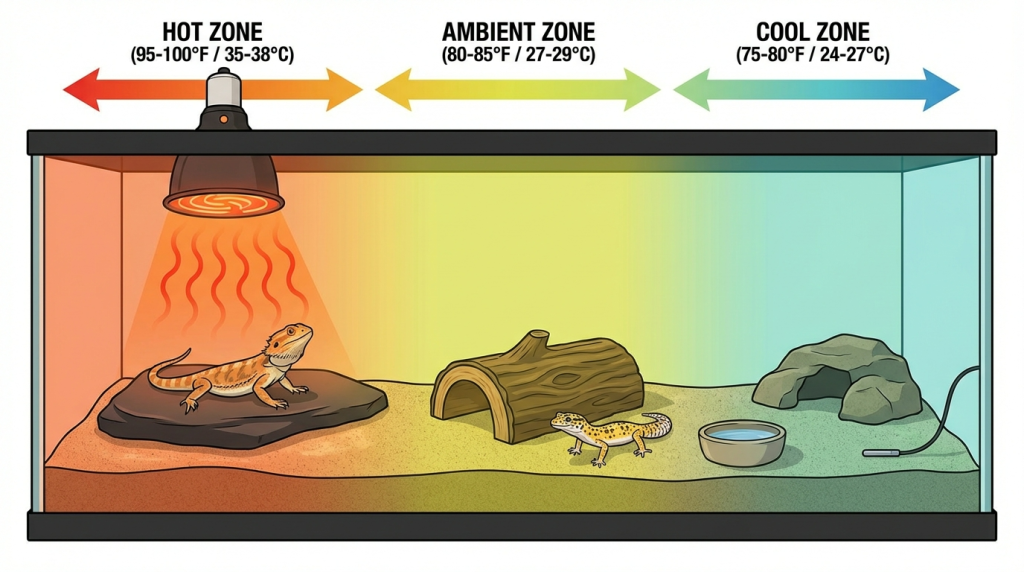
Reptile heat gradients refer to a range of temperatures within an enclosure. One side is warmer. The other side is cooler. Between those zones lies a smooth transition.
Think of it as a temperature highway. Your reptile chooses the lane it needs at any moment.
For example, a bearded dragon may bask at 100°F. Later, it may retreat to a 75°F area. That movement regulates its metabolism. Therefore, reptile heat gradients mimic nature’s flexibility.
Without that range, the reptile is trapped in a single temperature. Imagine living in one fixed climate every hour of your life. Eventually, your body would struggle.
Why Reptile Heat Gradients Support Digestion
Digestion in reptiles depends heavily on external heat.
When a reptile eats, it often seeks warmth. This behavior is instinctive. Heat activates digestive enzymes. It also speeds metabolic processes.
If reptile heat gradients are missing, food may sit undigested. As a result, bloating or regurgitation can occur. In severe cases, impaction develops.
Because digestion relies on warmth, the basking area must be precise. Too cool, and digestion slows. Too hot, and dehydration risk increases.
Therefore, proper heat gradients protect internal organs and promote nutrient absorption.
Reptile Heat Gradients and Immune Function
Temperature influences immunity more than many owners realize.
When reptiles become ill, they instinctively seek warmer zones. This response boosts immune efficiency. It is sometimes called behavioral fever.
However, if reptile heat gradients are absent, the animal cannot adjust. Consequently, minor infections may worsen.
Stable temperature zones also reduce chronic stress. And lower stress supports stronger immune defenses.
In captivity, temperature is medicine. It is comfort. It is survival.
How Reptile Heat Gradients Influence Behavior
Behavior changes dramatically when heat gradients are incorrect.
A reptile kept too cold may appear lethargic. It may refuse food. On the other hand, one kept too warm may constantly hide.
Proper reptile heat gradients allow natural behavior to emerge. You will see basking, exploring, and resting in balance.
Additionally, breeding behaviors depend on temperature cycles. Without proper gradients, reproductive health can be affected.
Behavior tells a story. Temperature often writes the script.
Creating Effective Reptile Heat Gradients
Now that you understand their importance, how do you create reptile heat gradients correctly?
First, select an appropriately sized enclosure. Larger enclosures make gradients easier to establish. Small tanks trap heat too uniformly.
Next, place the primary heat source on one side only. This setup naturally creates a warm zone and a cool zone.
Common heat sources include:
- Basking bulbs
- Ceramic heat emitters
- Under-tank heaters
- Radiant heat panels
However, never heat the entire enclosure evenly. That defeats the purpose.
Additionally, use thermostats. Temperatures must be controlled. Without regulation, overheating can occur quickly.
Measuring Reptile Heat Gradients Accurately
Guesswork is dangerous.
Use digital thermometers on both ends of the enclosure. Infrared temperature guns help measure surface heat precisely.
For example, the basking spot may read 95–105°F depending on species. Meanwhile, the cool side may remain 70–80°F.
Because reptile heat gradients vary by species, research is essential. Desert reptiles require higher basking temperatures than tropical geckos.
Monitoring ensures safety. It also prevents silent problems.
Species-Specific Heat Gradient Needs
Different reptiles need different gradients.
Bearded dragons require strong basking zones. Ball pythons need moderate warmth with secure hides. Leopard geckos prefer belly heat with cooler retreats.
Therefore, reptile heat gradients must be tailored. There is no universal temperature chart.
Furthermore, nighttime drops are often beneficial. Many species experience cooler evenings in nature. Mimicking that rhythm supports hormonal balance.
Consistency matters. However, natural fluctuation also plays a role.
The Dangers of Poor Heat Gradient Design
Improper reptile heat gradients cause more harm than many owners expect.
If temperatures are too low, digestion slows. Metabolic bone disease may develop due to nutrient imbalance. Appetite decreases.
If temperatures are too high, dehydration becomes a risk. Chronic overheating may lead to organ stress.
In some cases, reptiles become aggressive or withdrawn due to discomfort.
Because reptiles cannot verbally express distress, symptoms are often subtle at first.
Prevention is always easier than correction.
Lighting and Reptile Heat Gradients
Heat and light often work together.
Basking bulbs provide both illumination and warmth. However, nighttime heat should not disrupt sleep cycles. Ceramic emitters are useful because they emit heat without visible light.
Additionally, UVB lighting must be paired properly with heat zones. Reptiles often bask under UVB to synthesize vitamin D3.
Therefore, align UVB fixtures with basking areas. This arrangement supports calcium absorption.
When reptile heat gradients and lighting work together, overall health improves dramatically.
Humidity and Heat Balance
Humidity interacts with temperature.
In tropical species, warm air holds moisture. However, excessive heat may dry the enclosure too much.
Monitor humidity alongside reptile heat gradients. Use hygrometers to track levels accurately.
For example, ball pythons require higher humidity than desert reptiles. Therefore, misting may be needed on the cool side.
Balancing heat and humidity creates environmental harmony.
Seasonal Changes and Heat Gradients
Some reptiles benefit from seasonal cooling periods. This practice is known as brumation.
During cooler months, temperatures may be slightly lowered. However, gradients should still exist.
Even in winter adjustments, reptiles need choice.
Gradual transitions are essential. Sudden changes can cause stress.
Therefore, reptile heat gradients should evolve thoughtfully, not abruptly.
Troubleshooting Heat Gradient Problems
If your reptile stops eating, check temperatures first.
If shedding is incomplete, humidity and heat may be unbalanced. If lethargy appears, reassess gradient accuracy.
Sometimes heat bulbs are too powerful. Other times, enclosures are too small to create proper zones.
Because reptile heat gradients affect every system, troubleshooting begins with temperature verification.
Small adjustments often produce major improvements.
Why Heat Gradients Reflect Responsible Care
Providing reptile heat gradients is a sign of advanced husbandry.
It shows you understand biology, not just decoration. It reflects commitment to long-term health.
Reptiles depend entirely on artificial environments in captivity. Therefore, responsibility rests fully on the keeper.
Creating proper gradients is not difficult. However, it requires attention and monitoring.
And when done correctly, the results are visible. Appetite stabilizes. Activity increases. Shedding improves.
Health becomes consistent.
Conclusion: Temperature Is Life
Reptile heat gradients are not accessories. They are life support systems.
From digestion to immunity, from behavior to reproduction, temperature governs everything. Without proper gradients, reptiles cannot regulate themselves.
However, when warm and cool zones are carefully designed, reptiles thrive. They move naturally. They eat reliably. They live longer.
So look at your enclosure today. Measure both sides. Adjust if necessary.
Because in the reptile world, temperature is not comfort alone. It is survival.
FAQs
- What are reptile heat gradients?
Reptile heat gradients are temperature ranges within an enclosure that allow reptiles to move between warm and cool areas. - Why are reptile heat gradients important?
They support digestion, immune function, metabolism, and natural behavior in captive reptiles. - How do I create reptile heat gradients in a tank?
Place a heat source on one side of the enclosure and monitor temperatures using digital thermometers and thermostats. - Can reptiles survive without heat gradients?
They may survive temporarily, but long-term health problems often develop without proper temperature variation. - Do all reptiles need the same heat gradient?
No, each species has specific temperature requirements, so research and customization are essential.