
Rabbit litter training is often easier than new owners expect, because many rabbits naturally choose one or two spots as a toilet. Your job is to put a tray in the right place, make it inviting and stay patient while your rabbit learns. This guide explains how to choose a tray, pick a suitable litter and use hay to encourage good habits. It also covers how to clean up accidents and the common mistakes that slow progress.
Who this guide is for
This guide is for owners of house rabbits, as well as owners whose rabbits spend time indoors in a pen or room. It also helps if your rabbit was once reliable but has started having accidents again. The steps work for young and adult rabbits alike, although every rabbit learns at its own pace. If your rabbit seems unwell at any point, speak to your vet before you continue training.
Step 1: Choose a tray for rabbit litter training
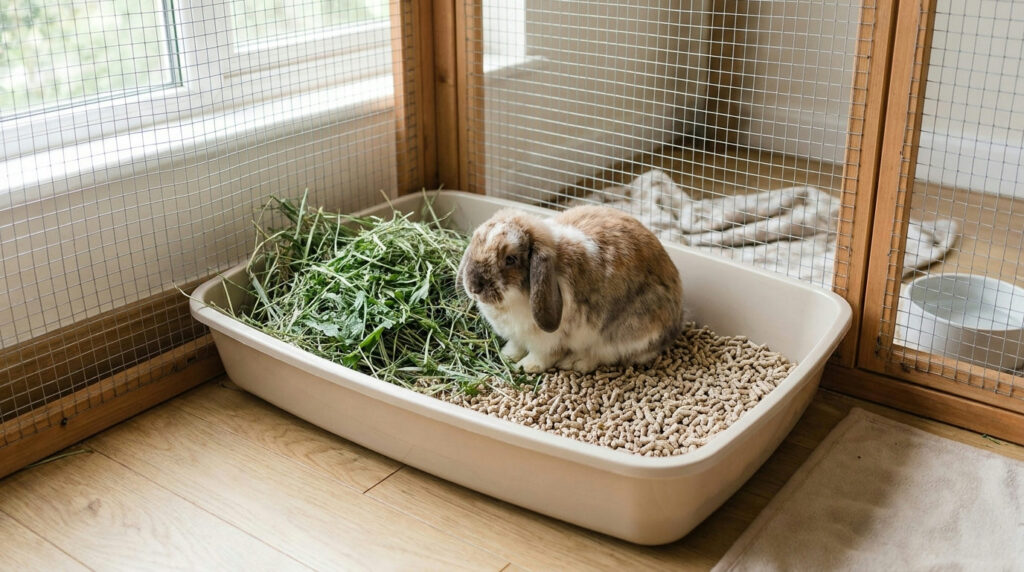
The right tray makes rabbit litter training much smoother. Rabbits like to sit, turn around and graze in their tray, so it needs to feel roomy and comfortable.
- Pick a large tray. Your rabbit should be able to sit fully inside and turn around easily.
- Choose a low entrance. Low sides or a cut-down front help young, small or older rabbits hop in.
- Go for easy-clean plastic. Plastic trays are simple to wash and dry.
- Skip wire grids. Avoid trays with wire bottoms or grates, which can be uncomfortable for feet.
- Consider more than one. If your rabbit has a large space, extra trays make it easier to get things right.
Step 2: Place the tray where your rabbit already goes
Placement matters more than almost anything else. Rabbits tend to pick a corner and stick to it. Rather than fighting that choice, work with it.
- Start your rabbit in a smaller area, such as a pen or one room.
- Watch where your rabbit chooses to toilet. Often, this will be a corner.
- Put the tray in that exact spot.
- Next, place a few droppings and a little soiled litter in the tray. The familiar scent tells your rabbit this is the right place.
- Once your rabbit uses the tray reliably, slowly give it more space to explore.
- If your rabbit picks a new corner in the larger space, add a second tray there.
Step 3: Choose a suitable litter
Rabbits often nibble on things in their tray and spend time resting in it. For this reason, choose a litter that is safe, low-dust and absorbent.
| Litter type | Use or avoid? | Notes |
|---|---|---|
| Paper-based pellets or bedding | Suitable | Absorbent and low-dust; easy to find in pet shops |
| Wood-based pellets made for small pets | Suitable | Choose unscented types sold for small animals |
| Clumping cat litter | Avoid | Not suitable for rabbits, which may nibble their litter |
| Clay or scented cat litter | Avoid | Not designed for rabbits; scents and dust can be irritating |
| Strongly scented wood shavings | Avoid | Ask your vet or a rabbit care sheet before using any wood shavings |
A thin layer of litter in the base of the tray is usually enough, because the hay on top does much of the work. Stick with one litter type once your rabbit is using it well, since sudden changes can confuse it.
Step 4: Add hay at the tray
Many rabbits like to eat and toilet at the same time. As a result, hay is one of the most useful tools in rabbit litter training.
- Put a generous pile of fresh hay in the tray, on top of the litter.
- Alternatively, hang a hay rack just above or beside the tray, so your rabbit sits in the tray to eat.
- Top up the hay often, so it stays fresh and appealing.
- Keep plenty of hay available elsewhere too, so your rabbit always has enough to eat.
Step 5: Build good habits with patience
Rabbits learn best through calm routines and gentle encouragement. In contrast, scolding usually makes a rabbit nervous and less likely to use the tray.
- Keep your rabbit’s space the same while it learns. Avoid moving the tray around.
- When you see your rabbit start to toilet outside the tray, gently guide it back without fuss.
- Pop stray droppings into the tray, so the scent stays in the right place.
- Offer quiet praise or a small, rabbit-safe treat when your rabbit uses the tray.
- Expand your rabbit’s space in small stages, and step back to a smaller area if accidents increase.
- Keep the home calm. Loud noises and big changes can lead to temporary setbacks.
Expect a few stray droppings even from a well-trained rabbit. Rabbits sometimes leave droppings to mark their territory, which is normal behaviour rather than a training failure.
Step 6: Clean up accidents and keep the tray fresh
How you clean has a big effect on future habits. If an area still smells of urine, your rabbit may return to it.
- Blot up urine first, then clean the spot with a pet-safe cleaner designed to remove odours.
- Avoid strong-smelling household cleaners, which can bother a rabbit’s sensitive nose.
- Pick up stray droppings and place them in the tray.
- Once your rabbit uses the tray reliably, empty and refresh it regularly. Many owners change the whole tray rather than spot cleaning, because urine can build up in the litter.
- Wash the tray with warm water and a pet-safe cleaner, and dry it before refilling.
Neutering and litter habits: ask your vet
Owners often wonder whether neutering affects litter habits. This is a question to discuss with your vet, who can advise on your own rabbit’s situation, age and health.
A hypothetical example
This example is hypothetical and is included only to show how the steps fit together. Imagine an owner bringing home an adult rabbit and setting up a pen in the living room. For the first stretch, the rabbit keeps using the back left corner, so the owner moves a roomy tray there. Next, they add paper-based litter, a pile of fresh hay and a few droppings from the floor. After that, the rabbit uses the tray most of the time. When the owner opens up the room, the rabbit starts using a spot behind the sofa, so a second tray goes there. Over time, both trays become part of the rabbit’s routine.
Common mistakes to avoid
| Mistake | Why it causes problems | What to try instead |
|---|---|---|
| Giving too much space too soon | Your rabbit may choose new toilet spots far from the tray | Start small and expand slowly |
| Putting the tray where you want it | Your rabbit may ignore a spot it did not choose | Place the tray where your rabbit already goes |
| Using a tray that is too small | Your rabbit may hang over the edge or avoid it | Choose a roomy tray with a low entrance |
| Cleaning the tray too thoroughly at first | The tray loses the scent that marks it as a toilet | Leave a few droppings in the tray early on |
| Telling your rabbit off | Fear can make accidents more likely | Stay calm and guide your rabbit back to the tray |
| Forgetting the hay | The tray is less appealing to sit in | Keep fresh hay in or beside the tray |
If accidents start suddenly in a rabbit that was reliable, or you notice changes in its droppings, urine, appetite or movement, contact your vet.
For more on rabbits and other small companions, visit our small pets guides.
Where to read more: House Rabbit Society: litter training and RSPCA Australia: how do I litter train my rabbit?.
Key takeaways
- Choose a large tray with a low entrance and no wire grid.
- Place the tray where your rabbit already likes to toilet.
- Use a paper-based or wood-based litter made for small pets, and avoid clumping cat litter.
- Add plenty of fresh hay in or beside the tray.
- Start in a small space and expand slowly, with calm, patient encouragement.
- Clean accidents with a pet-safe odour remover, and ask your vet about anything health-related.
With the right tray, a good spot and plenty of patience, rabbit litter training can give you a cleaner home and a happier, more settled rabbit.
Written by the Types of Pets Editorial desk. This guide is general information, not veterinary advice; talk to your vet about your own pet. Disclosure: this guide contains no affiliate or sponsored links.