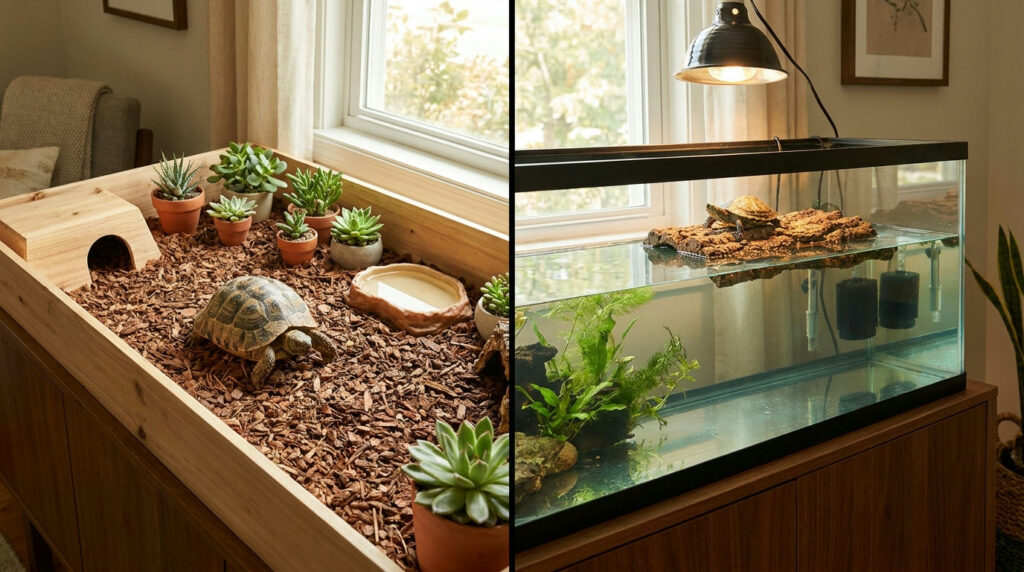

If you are weighing up tortoise vs turtle as a first reptile, the choice comes down to one big difference: where the animal lives. Tortoises live on land, while pet turtles spend much of their time in water. That single fact shapes the enclosure, the lighting, the food and the daily routine. This guide sets the two side by side so you can choose the one that fits your home.
Who this guide is for
This guide is for families and individuals thinking about their first shelled pet. It also suits anyone who has seen both in a pet shop or rescue and is unsure which to pick. It does not replace a species-specific care sheet. Instead, it helps you understand the broad trade-offs before you look at individual species and talk to an exotics vet.
The basic difference: land vs water
All tortoises are a kind of turtle, but in everyday pet-keeping the words point to very different animals. A tortoise is a land animal. It has sturdy, column-like legs for walking and usually a high, domed shell. It drinks and soaks but does not swim.
Pet turtles, by contrast, are aquatic or semi-aquatic. They usually have flatter, smoother shells and webbed feet or flippers for swimming. Many spend most of the day in water and climb out to bask. In some countries, people also call freshwater species “terrapins”. If you are not sure what an animal is, ask the shelter, breeder or an exotics vet to confirm the species before you buy anything.
Housing: dry enclosure vs water and basking area
Housing is where the tortoise vs turtle decision gets practical. The two setups look and work very differently.
Tortoise housing
Tortoises need a roomy, dry enclosure with solid sides and good airflow. Many keepers use an open-topped indoor pen, often called a tortoise table, plus a secure outdoor area for warm weather. Inside, plan for:
- A warm end and a cooler end, so your tortoise can move between them.
- A hide at each end for rest and security.
- A safe, diggable substrate suited to the species.
- A shallow water dish that is easy to climb in and out of.
- Daily spot-cleaning and a regular deeper clean.
Turtle housing
Aquatic turtles need a large tank with both water and a dry land area. In practice, that means:
- Water deep enough to swim in, with a gentle ramp or slope out.
- A dry, stable basking platform under a heat source.
- A strong filter, because turtles produce a lot of waste.
- Regular partial water changes and water testing.
- Guards around heaters and lamps so your turtle cannot touch them.
Turtles also tend to grow, so many owners need a bigger tank later on. Check the adult size of the species before you set up.
Lighting and heat
Both tortoises and turtles rely on their surroundings for warmth. As a result, both need a basking spot with heat and suitable UV lighting. Both also need a cooler area so they can regulate their own temperature.
However, the right temperatures, light type and daily lighting schedule are species-specific; check a care sheet. Aquatic turtles may also need the water kept within a certain range. Use thermometers at both ends of the enclosure, and replace UV bulbs as the maker recommends, since their output fades over time. If you are unsure, an exotics vet can help you set things up.
Diet differences in broad terms
Diet is another clear split in the tortoise vs turtle comparison.
- Tortoises are mostly plant eaters. Many species do well on a varied mix of safe weeds, leafy greens and plants, with fresh water always available.
- Aquatic turtles are often omnivores. Their diet commonly mixes prepared turtle food, some animal foods and leafy greens, and many eat in the water.
Within each group, needs vary by species and life stage. Some keepers also use supplements, but the right approach depends on the animal, so ask an exotics vet rather than guessing. Avoid feeding human snacks or food from your own plate.
Long lifespans as a commitment
Both tortoises and turtles can live for a very long time with good care. Some may outlive their first owner. Before you commit, think honestly about the long term:
- Who will care for the animal if you move, travel or your circumstances change?
- Can you keep up with equipment, bulbs and vet visits for many years?
- Will the enclosure still fit your home when the animal is fully grown?
Planning ahead is part of responsible ownership, not an optional extra.
Handling and hygiene
Neither tortoises nor turtles are cuddly pets. Most prefer to be watched rather than held. When you do need to pick one up, support the body from underneath with both hands and keep it low to the ground. Avoid holding it upside down or for long periods. Wash your hands after handling. Clean your hands and any tools after tank or enclosure maintenance too.
Tortoise vs turtle comparison table
| Factor | Tortoise | Turtle (aquatic or semi-aquatic) |
|---|---|---|
| Main habitat | Land | Water, with a dry basking area |
| Enclosure | Dry, roomy pen or table plus outdoor space | Large tank with water, ramp and basking platform |
| Cleaning | Spot-cleaning and substrate changes | Filter care, water changes and water testing |
| Lighting and heat | Basking heat and UV; species-specific | Basking heat and UV, often water heating; species-specific |
| Diet | Mostly plants | Often a mix of prepared food, animal foods and greens |
| Handling | Occasional, gentle, close to the ground | Minimal; most prefer to be watched |
| Lifespan | Very long; a long-term commitment | Very long; a long-term commitment |
Questions to ask before choosing
Run through this checklist before you settle the tortoise vs turtle question for your household:
- Do I have room for a large enclosure or tank, now and when the animal is fully grown?
- Am I happy doing regular water changes and filter care, or would I prefer a dry setup?
- Can I offer safe outdoor time in warm weather?
- Is there an exotics vet near me who sees reptiles?
- Have I read a care sheet for the exact species I am considering?
- Who in the household will do daily care, and who is the backup?
- Am I ready for a pet that may live for decades?
This example is hypothetical. Imagine a family with a sunny garden and limited time for tank cleaning. After reading care sheets, they lean toward a tortoise, because a dry pen suits their routine better than regular water changes. Meanwhile, a flat-dweller who enjoys aquarium upkeep might reach the opposite conclusion. Neither choice is wrong; the right one matches your space and habits.
Common mistakes to avoid
| Mistake | Why it causes trouble | What to try instead |
|---|---|---|
| Assuming all shelled pets need the same care | Land and water species have very different needs | Confirm the species and read its care sheet first |
| Buying a small starter tank or pen | Many species outgrow it | Plan for adult size from the start |
| Skipping UV lighting | Lighting is a core part of reptile care | Use suitable UV and replace bulbs as advised |
| Under-filtering a turtle tank | Water quality drops quickly | Choose a strong filter and test water regularly |
| Frequent handling | Can stress the animal | Handle only when needed, gently and low down |
| Guessing at diet | Needs vary by species | Follow a care sheet and ask an exotics vet |
Explore more reptile guides in our reptiles section.
Where to read more: Royal Veterinary College tortoise care sheet and Royal Veterinary College terrapin care sheet.
Key takeaways
- Tortoises live on land; pet turtles are aquatic or semi-aquatic.
- Tortoises need a dry, roomy enclosure, while turtles need a filtered tank with a basking area.
- Both need heat and UV lighting, and the exact setup is species-specific.
- Tortoises mostly eat plants, while many turtles eat a broader mix.
- Both can live a very long time, so plan for the long term.
- Handle gently and rarely, and wash your hands after handling.
Whichever you choose, matching the animal to your space, routine and long-term plans is the best start you can give it.
Written by the Types of Pets Editorial desk. This guide is general information, not veterinary advice; talk to your vet about your own pet. Disclosure: this guide contains no affiliate or sponsored links.