
Learning how to tame a budgie is mostly about earning trust, one calm session at a time. A budgie (often called a parakeet in the US) is a small prey bird, so a hand moving toward it can look like a threat at first. The good news is that most of the work is gentle and simple. You show up, you stay calm, and you let the bird decide when it is ready for the next step.
This guide walks through how to tame a budgie in order, from the first quiet days to safe time out of the cage. Every bird moves at its own pace, so treat each stage as a checkpoint, not a deadline.
Who this guide is for
This guide is for new budgie owners, people who have adopted an older or nervous bird, and anyone whose budgie still panics when a hand comes near. If your bird seems unwell, stops eating, or sits fluffed up on the cage floor, pause the training and contact an avian or exotics vet first.
Step 1: Let your new budgie settle in
A new home is full of strange sounds, smells and faces. The first part of how to tame a budgie is doing very little. Before you try any training, give your budgie time to learn that its cage is a safe place.
- Place the cage well. Choose a bright spot in a room where people spend time, but away from doors that swing open, busy walkways and the kitchen.
- Keep the cage simple at first. A few perches, food, water and one or two toys are enough. Too many items can crowd the space.
- Keep your hands out for now. Only reach in to change food and water, and move slowly when you do.
- Watch for normal behaviour. Eating, preening, chirping and exploring the cage are good signs that your bird is starting to relax.
Many owners find that a steady household routine helps a budgie settle. Feed at similar times each day and dim the room at the same time each evening.
Step 2: Sit near the cage and talk
Once your budgie eats and moves around normally, start spending quiet time beside the cage. This teaches the bird that your presence means nothing bad happens.
- Sit to the side of the cage rather than looming over it. Birds tend to feel safer when you are at or below their eye level.
- Talk or read aloud in a soft, even voice. Use the bird’s name often.
- Gradually move your chair closer over several sessions, but only when the bird stays calm at the current distance.
If your budgie flattens its feathers, freezes or flaps to the far side of the cage, you moved too fast. Simply go back to the last distance where it felt comfortable.
Step 3: Hand-feed a favourite treat
Food is the bridge between your bird and your hand. First, learn what your budgie likes most. Offer a few safe options in a dish and note which one it eats first. A sprig of millet is a common favourite. Next, keep that treat for training only, so it stays special.
Through the bars
- Hold the treat so it pokes through the bars near a perch your bird likes.
- Keep your hand still and wait. Let the bird come to the food.
- If it nibbles, stay calm and quiet.
At the open door
- When your bird eats happily through the bars, open the door and offer the treat just inside.
- Over later sessions, let your fingers show a little more, so the bird sees your hand as part of the reward.
- Finally, hold the treat so the bird has to lean toward your hand to reach it.
Step 4: Teach step-up with a perch or finger
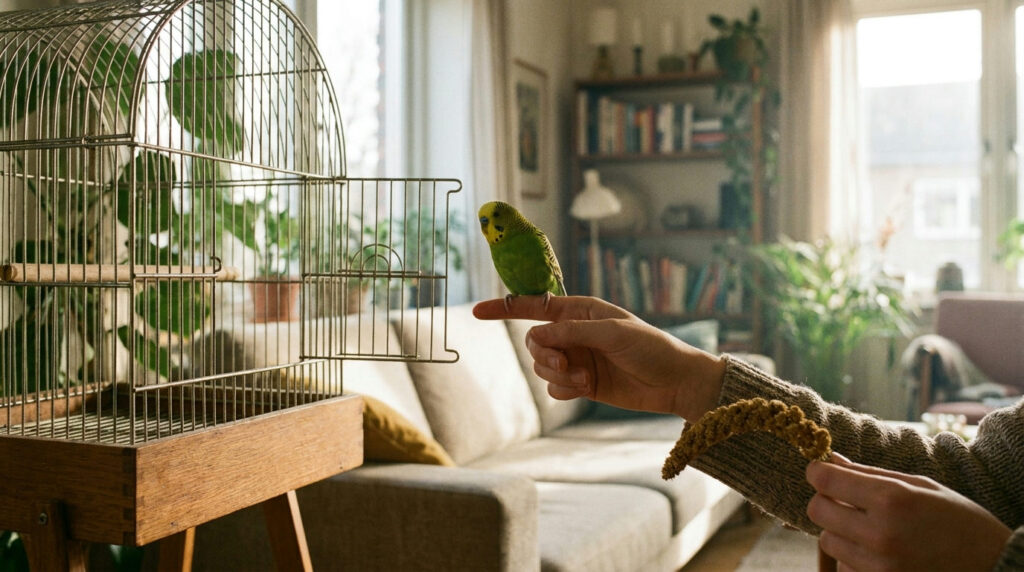
Step-up is the most useful skill a budgie can learn, and it sits at the heart of how to tame a budgie. It lets you move your bird calmly without grabbing it. You can start with a hand-held perch if your bird is still wary of fingers.
- Offer the perch or finger low. Hold it just above the bird’s feet and slightly in front of its chest, level and steady.
- Use the treat as a lure. Hold the treat a little behind the perch so the bird has to step forward to reach it.
- Reward one foot. At first, praise and reward even a single foot placed on the perch.
- Build to both feet. Once one foot is easy, move the treat back a little so the bird needs to step fully onto the perch.
- Add a cue. Say “step up” in the same tone each time, just as the bird steps.
- Switch to your finger. When step-up on the perch is reliable, offer your finger the same way.
Always let your budgie step on by itself. Pushing a finger into its belly or chasing it around the cage may break the trust you have built.
Step 5: Keep sessions short and read fear signals
Short, frequent sessions usually work better than long ones. End while your bird is still interested, ideally right after a success. Then everyone stops on a good note.
Learning your budgie’s body language helps you know when to push on and when to stop.
| What you see | What it may mean | What to try |
|---|---|---|
| Feathers held tight and thin, bird very upright | Alarm or fear | Stop, step back and try again later from further away |
| Frantic flapping or flying into the bars | Panic | End the session, leave the room quietly and keep the next session much easier |
| Open beak aimed at your hand, or a lunge | “Back off” warning | Move your hand away slowly and go back a step in training |
| Relaxed, slightly fluffed feathers and chattering | Comfort | A good moment for a short training step |
Step 6: Safe out-of-cage time in a bird-proofed room
Once your budgie steps up reliably inside the cage, you can think about time outside it.
Bird-proof the room first
- Close all windows and outside doors, and tell everyone at home that the bird is out.
- Cover or draw curtains over large windows and mirrors so the bird does not fly into them.
- Turn off ceiling fans and keep the bird away from hot stoves, open water and candles.
- Put other pets in a different room with the door shut.
- Remove small objects, cables and houseplants the bird could chew. If you are unsure whether a plant is safe, move it out.
Run the first sessions calmly
- Open the cage door and let the bird come out by itself.
- Stay in the room the whole time and keep things quiet.
- Use step-up and a treat to bring the bird back to the cage when the session ends.
- If the bird lands somewhere hard to reach, wait calmly or dim the lights a little rather than chasing it.
A hypothetical example
This example is hypothetical and is here only to show how the steps fit together. Sam brings home a young budgie named Kiwi. At first, Sam only changes food and water and talks softly from across the room. Once Kiwi preens and chirps, Sam moves closer. Next, Sam offers millet through the bars, and Kiwi takes it after a few tries. Later, Sam offers it at the open door. When Kiwi panics one evening after a loud noise, Sam goes back a step for a while. Eventually Kiwi steps onto a hand-held perch, then onto Sam’s finger, and finally enjoys calm time in a closed, bird-proofed room.
Common mistakes when learning how to tame a budgie
| Mistake | Why it causes problems | Better approach |
|---|---|---|
| Reaching in to grab the bird | It feels like a predator attack and may set training back | Let the bird come to you and step up by itself |
| Long sessions | The bird gets tired or stressed and stops learning | Keep sessions short and end on a success |
| Giving the favourite treat all day | The treat loses its value as a reward | Save it for training sessions only |
| Letting the bird out in an unprepared room | Open windows, fans and other pets put it at risk | Bird-proof the room before every session |
| Punishing bites or shouting | It teaches the bird that hands are scary | Stay calm, move away slowly and make the next step easier |
How to tame a budgie with patience
Some budgies take to hands quickly, while others need much longer. Age, past experience and personality all play a part. A bird that has lived without much handling may need extra time at each stage. That is normal.
Keep a simple note of each session. Write what you tried and how the bird reacted. If your bird stays fearful for a long time, or you notice changes in eating, droppings or behaviour, ask an avian or exotics vet for advice.
For more guides on keeping pet birds, visit our birds category.
Where to read more: RSPCA Australia: How should I handle my bird? and RSPCA Victoria: Bird care.
Key takeaways
- Let a new budgie settle before you start any hands-on training.
- Sit near the cage and talk softly so your presence feels safe.
- Hand-feed a favourite treat through the bars, then at the open door.
- Teach step-up with a perch or finger, and let the bird step on by itself.
- Keep sessions short, read fear signals and go back a step when needed.
- Bird-proof the room fully before any out-of-cage time.
With calm routines, small rewards and plenty of patience, you can learn how to tame a budgie in a way that keeps your bird relaxed and builds a lasting bond.
Written by the Types of Pets Editorial desk. This guide is general information, not veterinary advice; talk to your vet about your own pet. Disclosure: this guide contains no affiliate or sponsored links.